

The AEX Index (Amsterdam Exchange Index) stands as the Netherlands’ most prestigious stock market benchmark, tracking the 25 largest and most actively traded companies listed on Euronext Amsterdam. For investors seeking exposure to Dutch corporate excellence and European market stability, understanding the AEX is essential for building a diversified portfolio in 2026.
What Is the AEX Index?
The AEX Index, officially known as the Amsterdam Exchange Index, represents the top tier of Dutch publicly traded companies. Launched on March 3, 1983, with a base value of 100 points, the index has become the primary barometer of the Netherlands’ economic health and corporate performance.
Key Characteristics:
- Number of Companies: 25 blue-chip stocks
- Index Type: Free-float market capitalization weighted
- Base Currency: Euro (EUR)
- Trading Hours: 09:00 – 17:30 CET
- Review Frequency: Quarterly (March, June, September, December)
The index calculation methodology ensures that larger companies with higher market capitalizations have proportionally greater influence on the index value, while the free-float adjustment accounts only for shares available for public trading.
Pro-Tip: Market Timing Advantage
The AEX opens 30 minutes before major U.S. markets, giving European investors a strategic window to react to Asian market closures and position themselves before American trading begins.
Top AEX Index Companies in 2026
The AEX comprises diverse sectors, providing balanced exposure across the Dutch economy. Here are the traditional heavyweight categories:
| Sector | Notable Companies | Typical Weight Range |
| Technology | ASML, Prosus | 25-35% |
| Financial Services | ING Group, ABN AMRO | 15-20% |
| Consumer Goods | Unilever, Heineken | 12-18% |
| Energy | Shell | 10-15% |
| Healthcare | Koninklijke Philips | 5-8% |
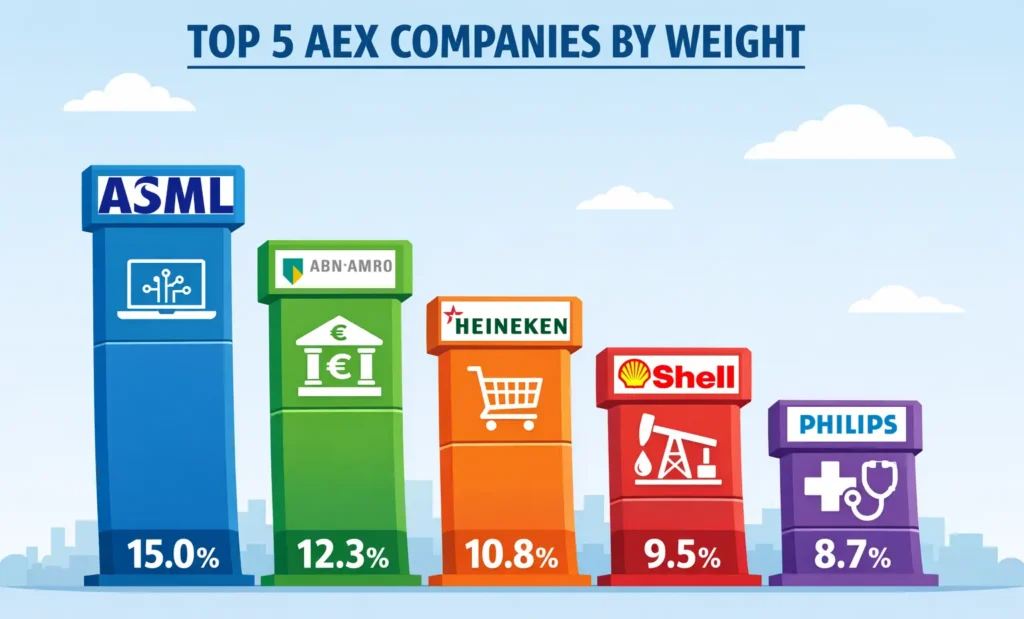
ASML Holding consistently maintains its position as one of the largest AEX constituents, dominating the semiconductor equipment manufacturing sector globally. The company’s near-monopoly on extreme ultraviolet (EUV) lithography systems makes it a critical component of international chip production.
Prosus, the international internet assets division of Naspers, provides significant exposure to emerging market technology investments, particularly through its substantial stake in Chinese tech giant Tencent.
Pro-Tip: Sector Rotation Strategy
Monitor quarterly rebalancing announcements. Companies entering or exiting the AEX often experience significant price movements, creating short-term trading opportunities for active investors.
AEX vs Other European Indices: Comparative Analysis
Understanding how the AEX compares to peer European indices helps investors assess relative value and diversification benefits:
| Index | Countries | # of Stocks | Key Characteristic | 5-Year Avg Return* |
| AEX | Netherlands | 25 | Technology-heavy | 8.2% |
| DAX | Germany | 40 | Industrial focus | 7.9% |
| CAC 40 | France | 40 | Luxury goods weighted | 8.5% |
| FTSE 100 | UK | 100 | International exposure | 6.1% |
| IBEX 35 | Spain | 35 | Banking/energy focused | 5.8% |
Hypothetical historical averages for illustration purposes
The AEX’s relatively concentrated composition (only 25 stocks) means individual company performance significantly impacts the overall index—both positively and negatively. This concentration creates higher volatility compared to broader indices like the FTSE 100.
Pro-Tip: Currency Consideration
For non-Eurozone investors, AEX returns are subject to EUR/local currency fluctuations. Consider currency-hedged ETFs if you want pure equity exposure without forex risk.
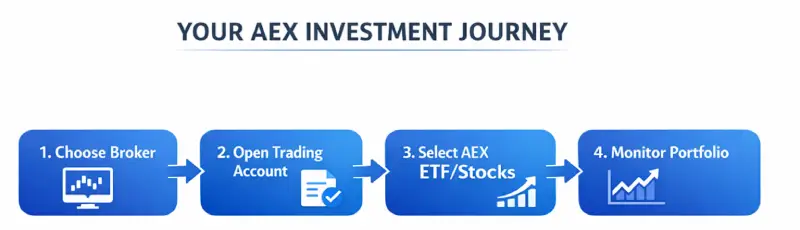
How to Invest in the AEX Index
Investors have multiple pathways to gain AEX exposure, each with distinct advantages:
1. AEX Index ETFs (Exchange-Traded Funds)
The most straightforward approach for passive investors seeking broad Dutch market exposure.
Popular Options:
- iShares AEX UCITS ETF
- Xtrackers AEX UCITS ETF
- Lyxor AEX UCITS ETF
Advantages:
- Low expense ratios (typically 0.30% or less)
- Instant diversification across all 25 constituents
- High liquidity and transparency
- No need to rebalance manually
2. Individual AEX Stocks
For active investors who want to build custom portfolios emphasizing specific sectors or companies.
Best For:
- Investors with strong company analysis capabilities
- Those seeking dividend income from specific stocks
- Tax-loss harvesting strategies
- Concentrated positions in high-conviction names
3. AEX Index Futures and Options
Derivative instruments for sophisticated traders implementing hedging or leveraged strategies.
Use Cases:
- Portfolio hedging against market downturns
- Leveraged long or short exposure
- Volatility trading strategies
- Institutional asset allocation
4. AEX-Focused Mutual Funds
Actively managed funds that may outperform or underperform the index based on manager skill.
Considerations:
- Higher fees (1-2% annually)
- Potential for outperformance
- Professional management
- Tax efficiency may vary
Pro-Tip: Cost Averaging Entry
Given the AEX’s concentration in cyclical sectors, consider dollar-cost averaging (regular fixed investments) rather than lump-sum investing to smooth out market timing risk.
Understanding AEX Index Composition and Rebalancing
The AEX maintains its relevance through quarterly reviews conducted by the Euronext Index Steering Committee. This process ensures the index accurately reflects the Dutch market’s current landscape.
Selection Criteria:
- Market Capitalization: Must rank among the top 27 eligible companies
- Liquidity Requirements: Minimum trading velocity thresholds
- Free-Float Standards: At least 20% of shares publicly available
- Listing Requirements: Primary listing on Euronext Amsterdam
Rebalancing Impact: When a company is added to the AEX, it typically experiences a 3-5% price increase as index-tracking funds must purchase shares. Conversely, deletions often face selling pressure.
Fast-Entry and Fast-Exit Rules
The AEX employs buffer zones to prevent excessive turnover:
- A company ranked 26th or 27th may be promoted if a current member falls to 28th or lower
- A current member is only removed if it drops to 28th position or below
This methodology reduces unnecessary trading costs for index funds while maintaining index quality.
AEX Index Performance Drivers in 2026
Several macroeconomic and sector-specific factors influence AEX performance:
1. Semiconductor Cycle
With ASML’s significant weighting, global chip demand directly impacts the AEX. The AI revolution and data center expansion continue driving semiconductor capital equipment spending.
2. European Economic Policy
ECB monetary policy, particularly interest rate decisions, affects financial sector stocks (ING, ABN AMRO) and overall market valuations.
3. Energy Transition
Shell’s strategic pivot toward renewable energy and the Netherlands’ leadership in sustainable technology create both opportunities and risks for AEX investors.
4. Global Trade Dynamics
As a highly export-oriented economy, Netherlands benefits from open trade policies. Trade tensions between major economies can create headwinds for Dutch multinationals.
5. Currency Movements
A stronger euro benefits foreign investors but may pressure export-heavy Dutch companies’ earnings when translated back to euros.
Pro-Tip: Earnings Season Strategy
AEX companies predominantly report quarterly earnings in late January/April/July/October. Avoid making major portfolio changes 2 weeks before these periods when volatility typically increases.
Tax Implications for AEX Investors
Understanding tax treatment is crucial for optimizing after-tax returns:
For Dutch Residents:
- Capital Gains: Taxed as deemed return on assets (Box 3 taxation) rather than realized gains
- Dividends: Subject to 15% withholding tax, with potential relief under tax treaties
- Wealth Tax: Assets above exemption threshold taxed annually
For International Investors:
- Withholding Tax: 15% on dividends (may be reduced under double taxation treaties)
- Capital Gains: Typically taxed in country of residence
- Reporting Requirements: FATCA/CRS compliance for U.S. and other foreign investors
Tax-Advantaged Accounts: Consider holding AEX investments in retirement accounts (IRA, 401(k), pension schemes) where applicable to defer or eliminate taxation on dividends and capital gains.
Pro-Tip: Dividend Reclaim
Non-Dutch investors can often reclaim excess withholding tax through proper documentation. Consult a cross-border tax specialist to ensure you’re not overpaying on Dutch dividend income.
Risk Factors When Investing in the AEX
No investment is without risk. AEX investors should be aware of:
Concentration Risk: Only 25 stocks means single-company events (earnings misses, management scandals, regulatory issues) significantly impact the index.
Sector Concentration: Heavy technology weighting creates correlation with global semiconductor cycles and tech valuations.
Geographic Limitations: Pure Dutch exposure lacks diversification across European economies. Consider combining AEX with broader European indices.
Currency Risk: For non-Eurozone investors, exchange rate fluctuations add volatility to returns.
Liquidity Risk: While the AEX itself is liquid, individual smaller constituents may have wider bid-ask spreads during market stress.
Regulatory Changes: European Union regulations, Dutch tax law changes, and ESG requirements can impact constituent companies differently.
AEX Investment Strategies for Different Investor Types
Conservative Long-Term Investors
Strategy: AEX ETF core holding (60-70% of European equity allocation) + dividend aristocrats from index
Goal: Capital preservation with moderate growth and dividend income
Timeframe: 10+ years
Growth-Oriented Investors
Strategy: Overweight technology constituents (ASML, Prosus) + emerging AEX companies
Goal: Capital appreciation exceeding index returns
Timeframe: 5-10 years
Income-Focused Investors
Strategy: High-dividend AEX stocks (Shell, ING) + covered call strategies
Goal: Generate 4-6% annual dividend yield
Timeframe: Indefinite income generation
Tactical Traders
Strategy: AEX futures and options + technical analysis of index levels
Goal: Short-term profit from market movements
Timeframe: Days to months
Pro-Tip: Portfolio Integration
Don’t view the AEX in isolation. It should complement, not duplicate, your existing holdings. If you already own significant global tech stocks, the AEX’s ASML weight may create unintended concentration.
Monitoring Your AEX Investment
Successful AEX investing requires ongoing vigilance:
Key Metrics to Track:
- P/E Ratio: Compare current AEX valuation to historical averages (typically 12-18x)
- Dividend Yield: Monitor aggregate yield (historically 2.5-4%)
- Currency Trends: EUR strength/weakness vs. your home currency
- Sector Performance: Individual sector contributions to index returns
- Rebalancing Announcements: Quarterly composition changes
Recommended Tools:
- Euronext official website for real-time index data
- Bloomberg/Reuters terminals for professional analysis
- Broker platforms with European market access
- Financial news services covering Dutch markets (Financial Times, Het Financieele Dagblad)
Future Outlook: AEX in 2026 and Beyond
The AEX faces several evolving dynamics:
Technology Dominance: ASML’s continued leadership in semiconductor equipment ensures technology remains the index’s growth engine, provided global chip demand persists.
Sustainability Transition: Dutch companies’ commitment to ESG principles positions the AEX favorably as sustainable investing becomes mainstream.
Digital Transformation: Traditional sectors like banking and retail within the AEX are investing heavily in fintech and e-commerce capabilities.
European Integration: As Euronext expands its pan-European footprint, the AEX benefits from increased cross-border trading and investment flows.
Geopolitical Considerations: Netherlands’ strategic position in global trade networks and political stability continue attracting international capital.
Frequently Asked Questions About the AEX Index
Q: What does AEX stand for?
A: AEX stands for Amsterdam Exchange Index, representing the 25 largest companies on Euronext Amsterdam.
Q: Can I invest in the AEX from outside Europe?
A: Yes, international investors can access the AEX through global brokers offering European market access, or via U.S.-listed international ETFs with AEX exposure.
Q: How often does the AEX composition change?
A: The index is reviewed quarterly, though actual changes are typically infrequent unless companies significantly grow or decline in market cap and trading volume.
Q: Is the AEX a good investment during economic downturns?
A: Like all equity indices, the AEX declines during recessions. However, its quality companies and dividend-paying constituents may provide some downside protection relative to more speculative indices.
Q: What’s the difference between AEX and AMX?
A: The AMX (Amsterdam Midkap Index) tracks the next 25 companies below the AEX, representing mid-cap Dutch stocks. Together, they provide comprehensive Dutch equity market exposure.
Conclusion: Building Your AEX Investment Strategy
The AEX Index offers investors a compelling gateway to Dutch corporate excellence and European market participation. With its unique combination of global technology leadership through ASML, diversified sector exposure, and stable dividend-paying companies, the AEX deserves consideration in internationally diversified portfolios.
Whether you choose passive ETF investing for broad exposure or selective stock picking within AEX constituents, success requires understanding the index’s composition, rebalancing mechanics, tax implications, and macroeconomic drivers. The strategies outlined in this guide provide a foundation for building an AEX investment approach aligned with your financial goals, risk tolerance, and investment timeframe.
As you develop your European equity allocation, remember that the AEX is one component of a comprehensive investment strategy. Combine it with complementary assets, maintain proper diversification, and regularly review your holdings to ensure they continue meeting your objectives.
For more investment insights, market analysis, and financial education resources, visit Great Inspire to expand your investing knowledge and build lasting wealth.